
Creep Test
Holds a constant stress and tracks slow deformation over time — viscoelastic behavior.
Part 1
What is Creep Test
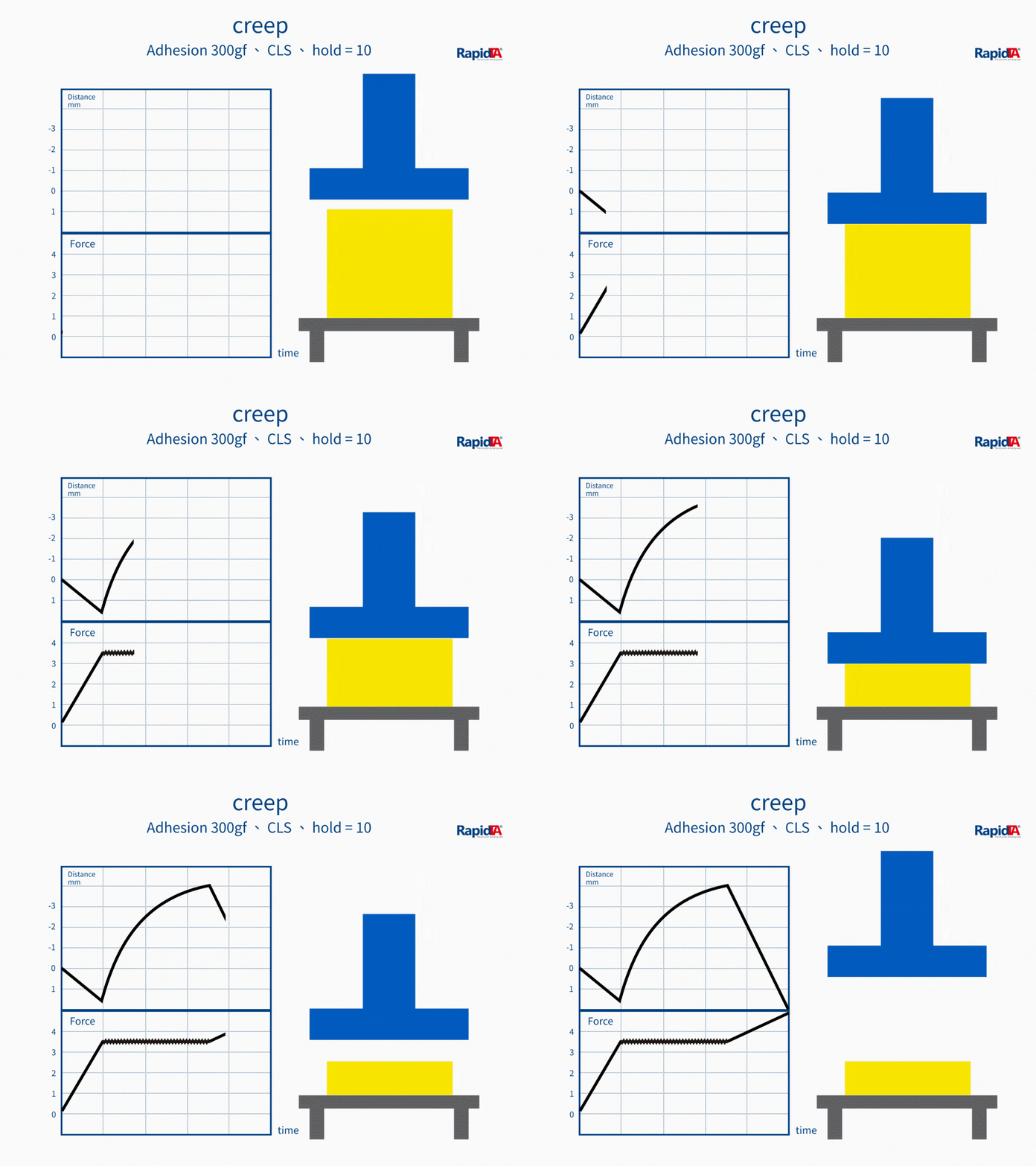
The creep test applies a constant stress and observes how deformation grows over time. It has a creep phase and a recovery phase, quantifying a food's rheological properties and viscoelastic structure.
Application Domains
Texture Properties Measured
Part 2
Principle & Operating Procedure
Principle
The creep test has two phases: a creep phase (constant stress, deformation grows with time) and a recovery phase (stress removed, recovery observed). The Burgers model (Maxwell and Kelvin–Voigt elements in series) describes instant elastic, retarded elastic and permanent viscous flow.
Operating Procedure
Apply constant stress
Apply a fixed stress or load to the sample.
Creep phase
Record deformation over time to get the creep curve.
Remove stress
Remove the load; the sample starts to recover.
Recovery phase
Record the recovery curve to separate instant, delayed and permanent deformation.
Calculate compliance
The software calculates creep compliance J(t) and model parameters.
Part 3
Probe Selection & Characteristics
Probe and fixture choice strongly affects accuracy and repeatability. The probes and kits below are commonly used for this action — select one to see its samples.
Creep probes and fixtures
Choose by sample shape
Dough, dairy, gels
Pick the probe and fixture to match the sample
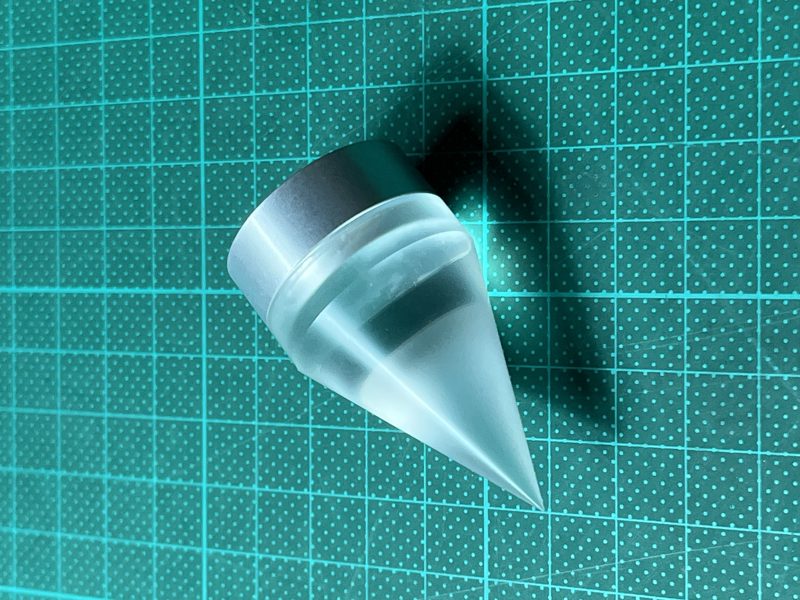
45° Conical probe_acrylic
CN4P
View probe & test kit →
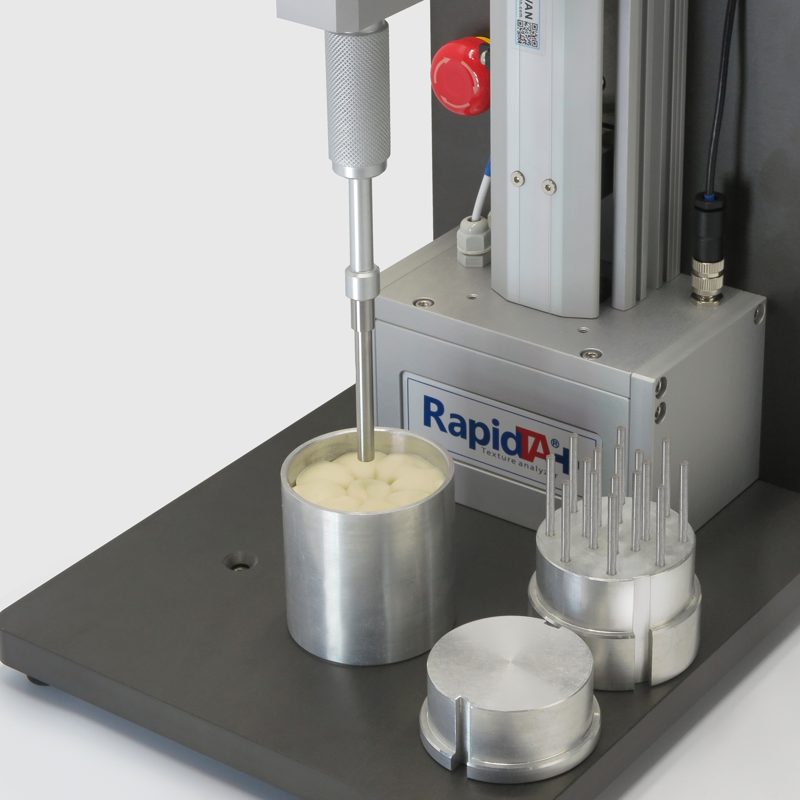
Dough hardness rig
DHT
View probe & test kit →
Part 4
Data Interpretation & Analysis
The creep curve plots strain against time. The slope during creep shows flow rate; instant and slow recovery during the recovery phase show elasticity; the permanent strain left is viscous flow. Fitting a Burgers model gives rheological parameters E₀, E₁ and η₀.
Test Curves & Diagrams
Parameters & Calculations
After a test, the software calculates these parameters from the curve
Creep compliance J(t)
Deformation per unit stress over time — the rheological behavior.
Formula:J(t) = 1/E₀ + 1/E₁(1 − e^(−t/λ)) + t/η₀
Instant elastic modulus E₀
Elastic response at the instant of loading.
Retarded modulus E₁ / retardation time λ
Strength and time scale of the delayed elastic response.
Part 5
Application Cases
Applicable Test Samples
These samples use this action — select one for the full test information
Part 6
Frequently Asked Questions
What is a Creep Test?
A Creep Test holds a fixed force or stress and observes how a sample deforms over time. It assesses time-dependent behavior and long-term stability under load.
How does a Creep Test differ from a Compression Test?
A Compression Test focuses on force and deformation during compression. A Creep Test focuses on how much a sample deforms over time under a fixed load.
Which products can be tested with a Creep Test?
Commonly used for materials with viscoelastic or time-dependent behavior, such as gels, jelly, dairy, dough, food colloids, gummy candy and polymers.
How long does a Creep Test usually run?
Test time depends on how quickly the sample deforms and on the test purpose, from seconds to minutes or hours. Slowly deforming samples usually need longer tests to show clear creep behavior.
What data does a Creep Test produce?
Mainly deformation, time and the creep curve. The curve compares samples' resistance to deformation and their long-term stability.
Related Test Actions
Stress Relaxation Test
Holds the probe at depth and tracks force decay over time — elastic recovery and shelf life.
Learn More →
Extrusion Test
Forward, back and bulk extrusion — rating consistency, firmness and crispness.
Learn More →
Adhesion Test
Measures the peak force to separate a probe from the sample surface — rating stickiness.
Learn More →
Not sure which texture test method fits your product?
Feel free to share your testing needs anytime — we provide free test method recommendations, custom fixture selection, instrument model suggestions, and tailored quotes.