
Extrusion Test
Forward, back and bulk extrusion — rating consistency, firmness and crispness.
Part 1
What is Extrusion Test
The extrusion test is one of the most widely used methods. Controlled extrusion force measures consistency, firmness and crispness. It can use forward extrusion, back extrusion or Ottawa bulk compression rigs to match how food flows, extrudes or is compressed in bulk.
Application Domains
Texture Properties Measured
Part 2
Principle & Operating Procedure
Principle
Depending on the sample and goal, extrusion uses one of three rigs: forward extrusion (flow resistance — spreadability and firmness), back extrusion (consistency and adhesion), or Ottawa bulk compression (overall firmness and crispness of granular or flaky solids).
Operating Procedure
Prepare
Choose the rig, fill the sample and let it reach temperature balance.
Run the extrusion
Extrude at the set speed; calculate over the stable plateau.
Capture and analyze
The software records the force curve and computes the positive average and more.
Compare results
Compare across batches, formulas or temperatures to set quality standards.
Recommended Settings
Standard or suggested parameters by sample and application — use them as a starting point.
Forward extrusion typical settings (margarine example)
| Parameter | Setting | Purpose |
|---|---|---|
| Test speed | 1 mm/s | Gives the sample time to flow |
| Test mode | Distance (c) | Controlled by displacement |
| Trigger (start) | 50 gf | Removes approach error |
| Target distance | 20 mm | Ensures a stable extrusion section |
| Hold | 0 sec | Continuous extrusion |
| Calculation window | 10–20 s | Positive average over the stable plateau |
Part 3
Probe Selection & Characteristics
Probe and fixture choice strongly affects accuracy and repeatability. The probes and kits below are commonly used for this action — select one to see its samples.
Forward extrusion cell
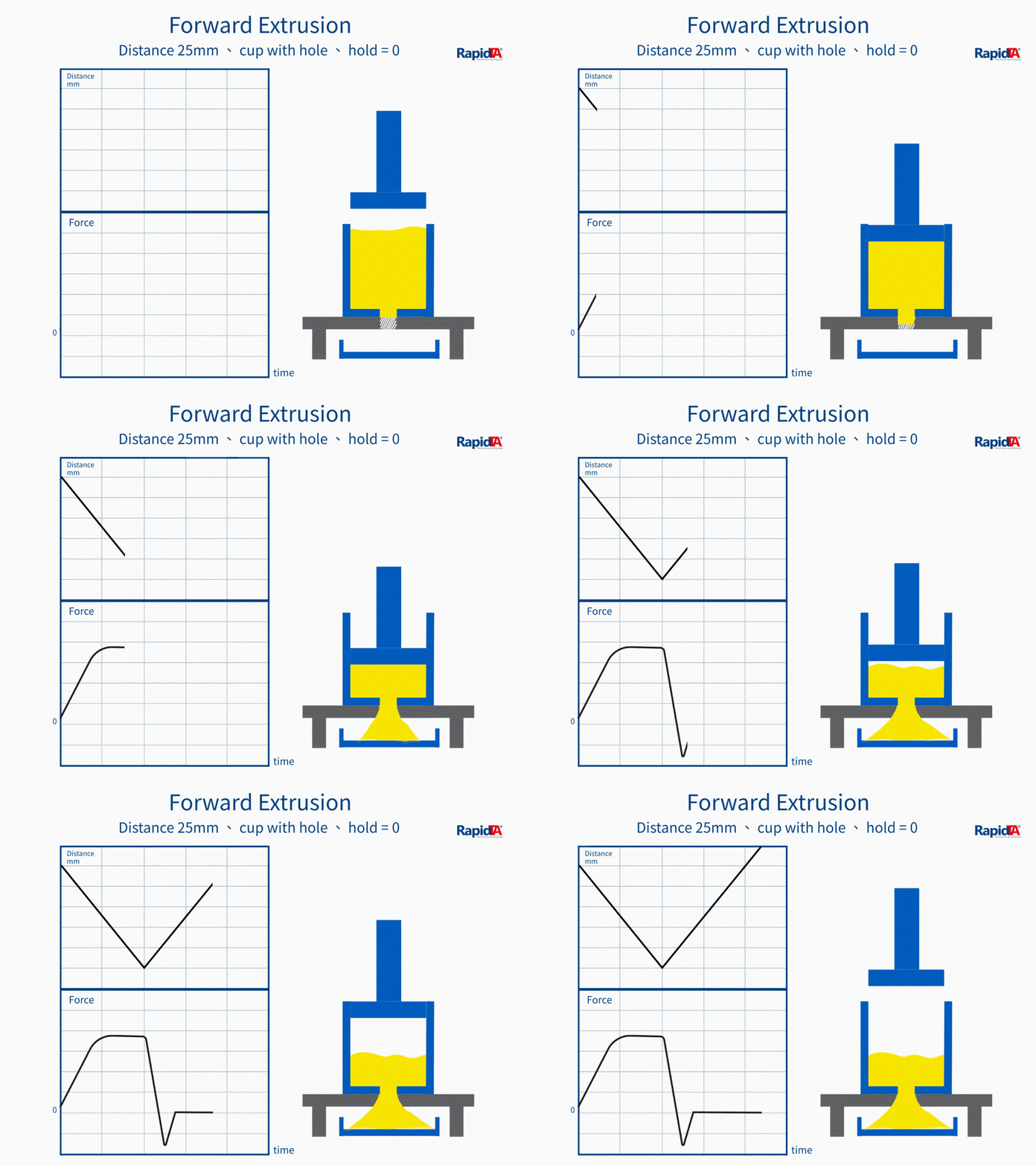
Forward extrusion rig
Margarine, butter, squeezable pastes
Flow resistance: spreadability and firmness
View probe & test kit →
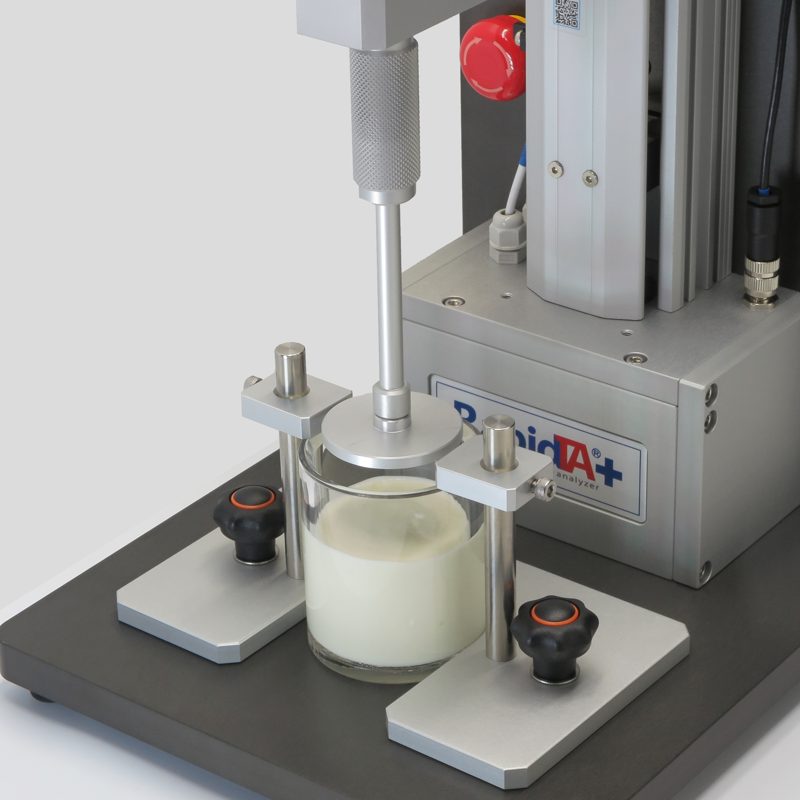
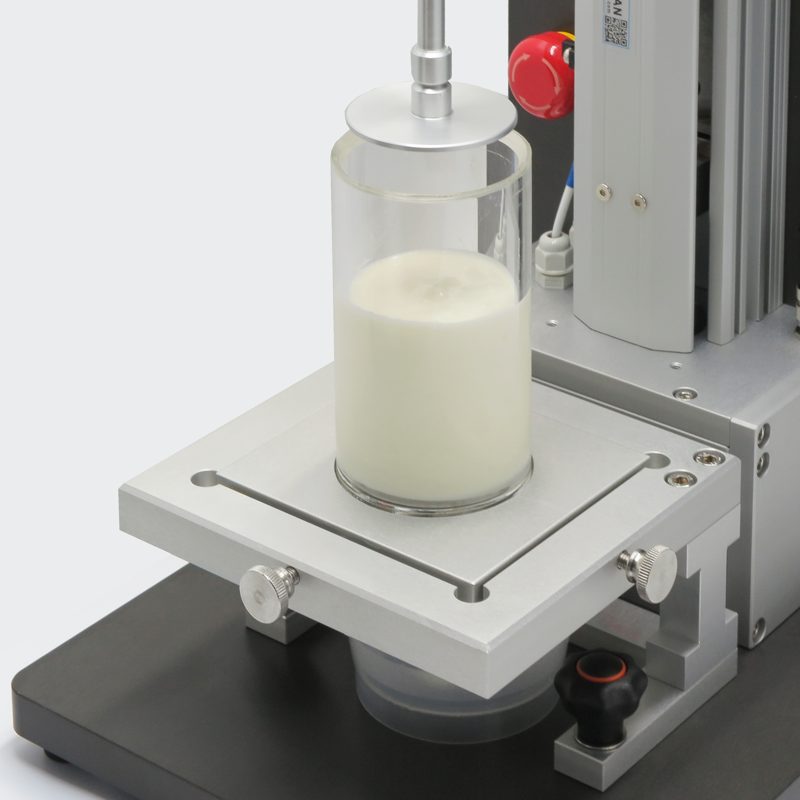
Back extrusion cell
Back extrusion rig
Cream, mayonnaise, yogurt, ketchup
Consistency and adhesion comparison
View probe & test kit →
Ottawa cell (bulk compression)
Bulk compression rig
Cereal, puffed rice, chips, prawn crackers
Whole-piece compression for firmness and crispness
View probe & test kit →
Part 4
Data Interpretation & Analysis
On extrusion curves, the positive average over the stable plateau gives consistency or flow resistance; the peak gives firmness; periodic oscillation in bulk compression means brittle pieces are breaking in sequence — a key sign of crispness. Avoid the unstable start and end when setting the window.
Test Curves & Diagrams
Chart coming soon
[TBD] No chart is available for this test action yet
Parameters & Calculations
After a test, the software calculates these parameters from the curve
Consistency
Positive average force on the plateau — resistance to flow or extrusion.
Formula:Positive average force on the plateau
Firmness
Peak extrusion force — the sample's firmness.
Crispness
Number and size of peaks as pieces break during bulk compression — crispness.
Part 5
Application Cases
Applicable Test Samples
These samples use this action — select one for the full test information
Margarine
Food
Croutons
Food
Puffed rice cereal
Food
Breakfast cereals
Food
Creme fraiche
Food
Mayonnaise
Food
Yoghurt
Food
Baked Beans
Food
Potato salad
Food
Instant mashed potato
Food
Raspberries
Food
Strawberries
Food
Potato crisps
Food
Tomato ketchup
Food
Mini popadoms
Food
Prawn crackers
Food
Application Cases & Data Examples
What each rig is for
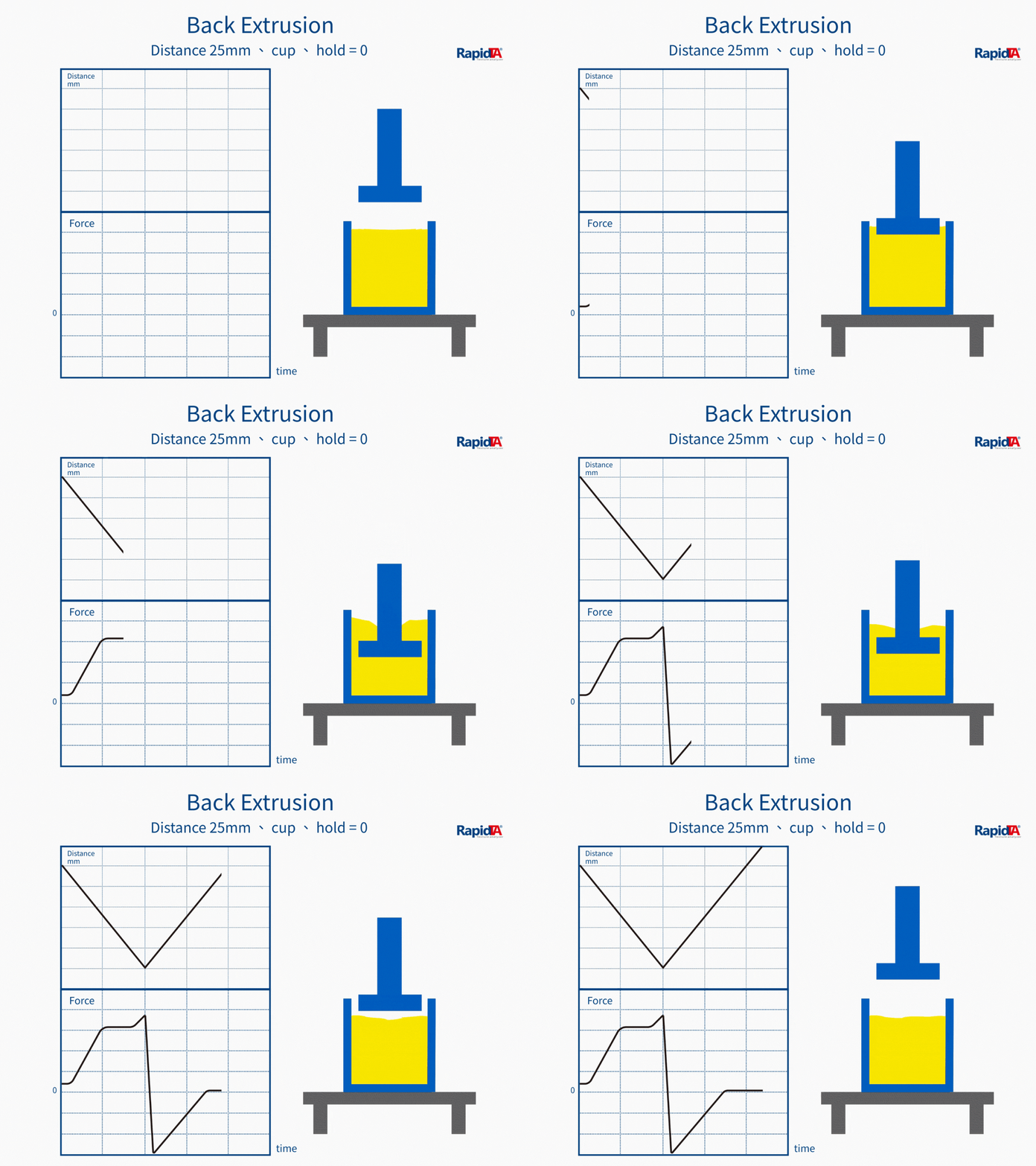
Forward (red): margarine, butter, squeezable pastes — flow resistance. Back (blue): cream, mayonnaise, yogurt, ketchup — consistency and adhesion. Ottawa bulk (green): cereal, puffed rice, chips, prawn crackers, beans, potato salad — overall firmness and crispness.
Part 6
Frequently Asked Questions
What is the real difference between forward and back extrusion?
Forward extrusion pushes the sample out through a small hole at the bottom of the container — for pastes and semi-solids, measuring extrusion resistance (spreadability/firmness). Back extrusion pushes a plunger into an open container full of sample, which flows up past the plunger edge — for liquids and semi-liquids, measuring consistency and adhesiveness. The probe moves the same way; the container and reading differ.
Which foods can the Ottawa bulk compression kit test?
It suits any granular, flaky or irregular solid food: cereal, potato chips, prawn crackers, crisp biscuits, puffed rice, beans, berries, potato salad. It needs no per-piece positioning; one compression gives representative texture for the whole batch — good for QC screening and shelf-life work.
Is force fluctuation on an extrusion curve normal?
In forward extrusion, some fluctuation can come from air pockets released during filling. In bulk compression, periodic oscillation means brittle pieces are breaking one after another — a useful crispness signal, not an error. If fluctuation is large and irregular, recheck filling and temperature equilibration.
How do I set the correct trigger force?
Set it above background noise and probe weight, but not so high that early contact data is lost. Soft foods: about 5–20 gf. Semi-firm foods: around 50 gf. Run an empty test first to check background force, then set it so every test starts at the same point.
Can back extrusion compare dairy products with different fat levels?
Yes — back extrusion is a standard way to compare consistency across whole, reduced-fat and low-fat dairy. Keep the temperature, fill height and probe depth the same for every sample. Cream, yogurt and mayonnaise all have established back-extrusion methods to follow.
Related Test Actions
Adhesion Test
Measures the peak force to separate a probe from the sample surface — rating stickiness.
Learn More →
Creep Test
Holds a constant stress and tracks slow deformation over time — viscoelastic behavior.
Learn More →
Tension / Extensibility Test
Pulls the sample vertically to measure extension and breaking force — extensibility and tensile strength.
Learn More →
Not sure which texture test method fits your product?
Feel free to share your testing needs anytime — we provide free test method recommendations, custom fixture selection, instrument model suggestions, and tailored quotes.