Burst Test
Biaxial loading of films and sheets — burst strength and extensibility.

Part 1
What is Burst Test
The burst test assesses the extensibility and burst strength of film-like, sheet-like or skin-like samples under biaxial stress. A spherical or cylindrical probe presses on the sample clamped over a circular hole, measuring burst strength, extensibility and distance at rupture. Used for pancakes, pastries, tortillas, rice paper and seaweed.
Application Domains
Texture Properties Measured
Part 2
Principle & Operating Procedure
Principle
The sample is clamped over a circular hole and a spherical or cylindrical probe presses it vertically until it bursts under biaxial stress. Burst strength, extensibility and rupture distance rate the stretch and toughness of thin products.
Operating Procedure
Prepare and clamp
Clamp the sample flat over the hole, without slack.
Choose the probe
Choose a spherical or cylindrical probe for the thickness and strength.
Press
The probe presses at the set speed until the sample bursts.
Record force and distance
Force and displacement are recorded continuously to catch the burst instant.
Recommended Settings
Standard or suggested parameters by sample and application — use them as a starting point.
Core parameter ranges
| Parameter | Range | Effect |
|---|---|---|
| Test speed | 0.5 – 10 mm/s | Key factor for results |
| Hole diameter | 15 – 50 mm | Choose by sample size |
| Probe size | Ø 5 – Ø 35 mm | Spherical or cylindrical |
| Max distance | 5 – 100 mm | Sets the stop condition |
| Force range | 1 – 51,000 gf | High-precision load cell |
| Sampling rate | Up to 2000 Hz | Captures the instant of rupture |
| Trigger force | 1 – 100 gf | Auto-detects contact |
Part 3
Probe Selection & Characteristics
Probe and fixture choice strongly affects accuracy and repeatability. The probes and kits below are commonly used for this action — select one to see its samples.
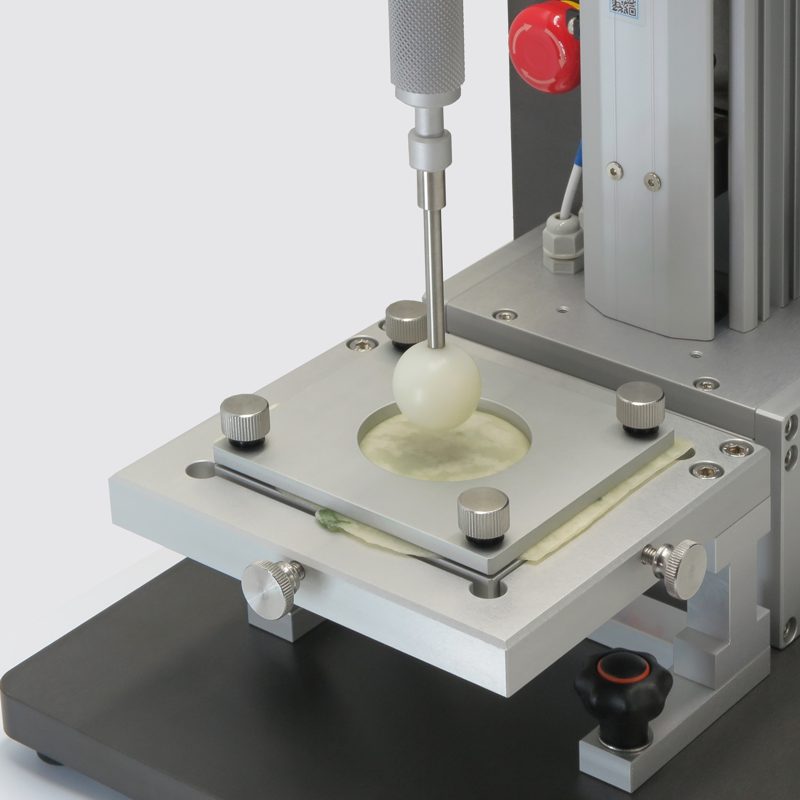
Dough burst rig (40 mm hole)
40 mm hole, spherical or cylinder Ø 25–35 mm
Pancakes, pastries, tortillas
AIB-recommended setup for planar extensibility
View probe & test kit →
Film puncture rig (5 mm ball)
Ball Ø 5 mm, hole 15–30 mm optional
Rice paper, seaweed, spinach leaves, gelatin sheets
For thin films and sheets; precise break detection
View probe & test kit →
Custom burst fixture
Designed to request
Special products or R&D needs
Simulates real use conditions
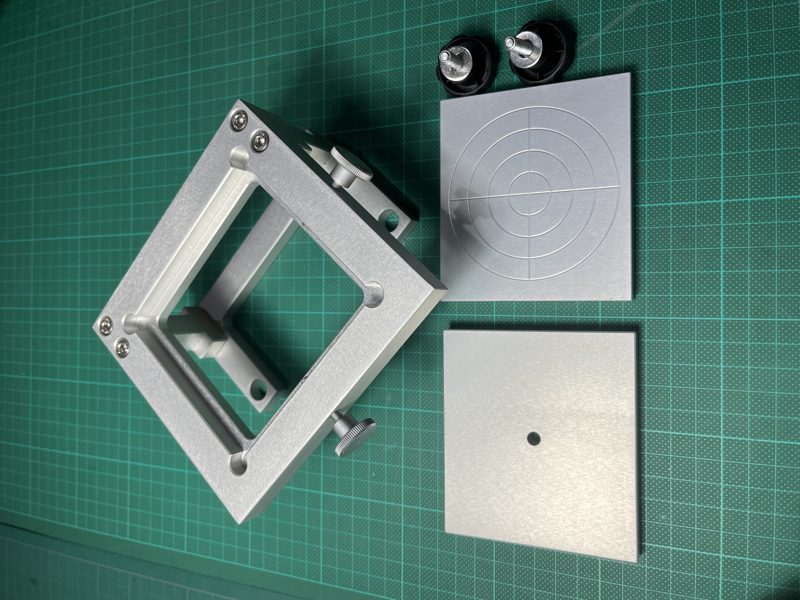
Platform
HPF
View probe & test kit →
Part 4
Data Interpretation & Analysis
Peak force at rupture reflects strength; rupture distance reflects extensibility and toughness; the area under the force–distance curve is rupture work, a combined toughness measure. Read all three together: high force with short distance means brittle; low force with long distance means soft and extensible; high on both means strong and tough.
Test Curves & Diagrams
Chart coming soon
[TBD] No chart is available for this test action yet
Parameters & Calculations
After a test, the software calculates these parameters from the curve
Burst strength
Peak force before rupture.
Formula:Peak force
Extensibility
Deformation distance before rupture — biaxial stretch.
Toughness
Area under the force–distance curve — energy absorbed before rupture.
Formula:Area under the curve
Part 5
Application Cases
Applicable Test Samples
These samples use this action — select one for the full test information
Part 6
Frequently Asked Questions
What is a Burst Test?
A Burst Test keeps applying force to a sample with a probe until its surface or structure ruptures (bursts). It assesses resistance to rupture and structural strength.
What products can be tested with a Burst Test?
Common applications include packaged foods, gummy candy, jelly, films, biscuits, crisps, food skins and other samples that crack or rupture.
What does a Burst Test measure?
Mainly burst force, the distance or deformation at rupture, and the force–distance curve, used to compare structural strength between samples.
How should I choose a probe for a Burst Test?
Choose the probe by sample size, thickness and structure. Small cylindrical, spherical or needle probes are common, because they focus force and rupture the sample locally.
Why do Burst Test results vary between samples?
Results can be affected by thickness, size, moisture content, temperature, probe shape, test speed and how the sample is held. Keep conditions consistent when comparing products.
Related Test Actions
Tension / Extensibility Test
Pulls the sample vertically to measure extension and breaking force — extensibility and tensile strength.
Learn More →
Puncture Test
Measures puncture resistance — surface hardness, fracturability and gel strength.
Learn More →
Stress Relaxation Test
Holds the probe at depth and tracks force decay over time — elastic recovery and shelf life.
Learn More →
Not sure which texture test method fits your product?
Feel free to share your testing needs anytime — we provide free test method recommendations, custom fixture selection, instrument model suggestions, and tailored quotes.