
Bending Test
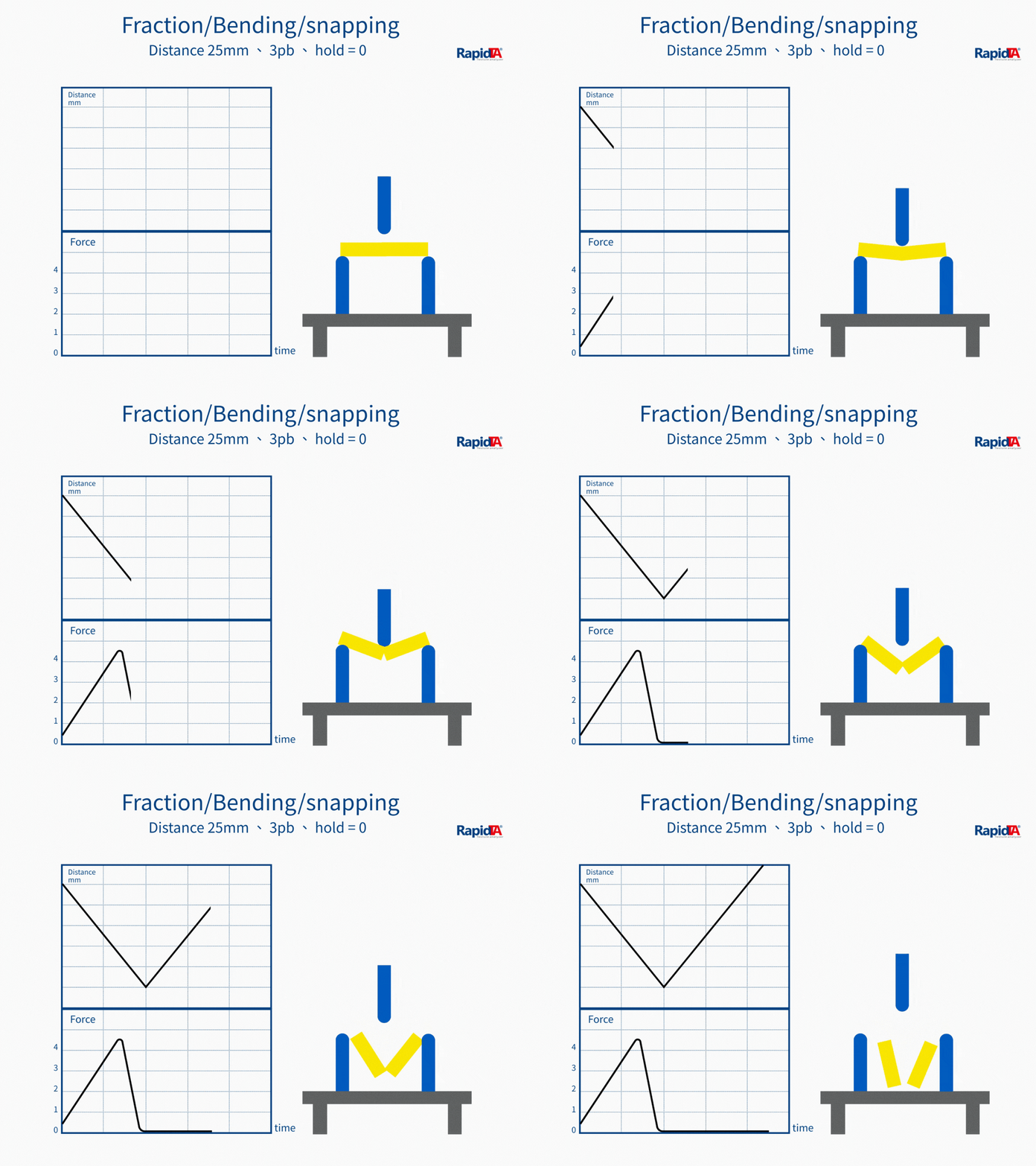
Three-point bending measures deflection and breaking force for brittle products.
Part 1
What is Bending Test
The bending test measures mechanical response under bending load. The common setup is three-point bending, measuring deflection, flexural strength and breaking force. It is widely used for brittle foods such as biscuits, crisps and pasta, and for thin materials.
Application Domains
Texture Properties Measured
Part 2
Principle & Operating Procedure
Principle
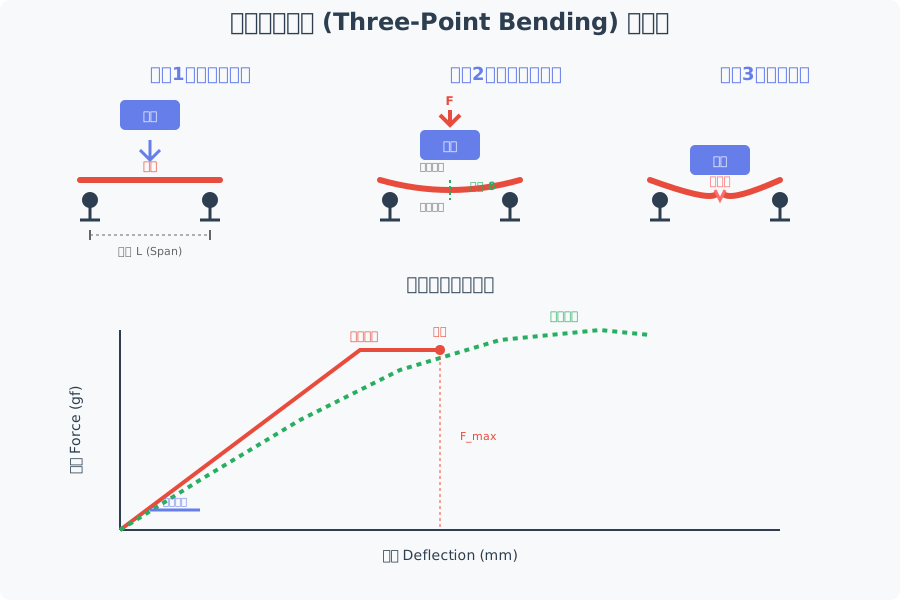
Three-point bending: the sample rests on two supports and a probe pushes down at the middle. Deflection and break force give flexural strength and the break point, rating brittleness or toughness.
Operating Procedure
Prepare and place
Place the sample on the supports, centered.
Set the span
Set the support span for the sample thickness.
Probe descends and loads
The probe loads from above and the sample starts to bend.
Record force and deflection
Force and deflection are recorded continuously until break.
Analyze
The software calculates flexural strength, break force and deflection.
Recommended Settings
Standard or suggested parameters by sample and application — use them as a starting point.
Core parameter ranges
| Parameter | Range | Effect |
|---|---|---|
| Test speed | 0.1 – 500 mm/min | Key factor for results |
| Span length | 5 – 200 mm | Adjust to sample thickness |
| Max deflection | 0.1 – 100 mm | Sets the stop condition |
| Force range | 1 – 100,000 gf | High-precision load cell |
| Sampling rate | Up to 2000 Hz | Captures the instant of break |
| Temperature | 5 – 80 °C | Optional chamber |
Part 3
Probe Selection & Characteristics
Probe and fixture choice strongly affects accuracy and repeatability. The probes and kits below are commonly used for this action — select one to see its samples.
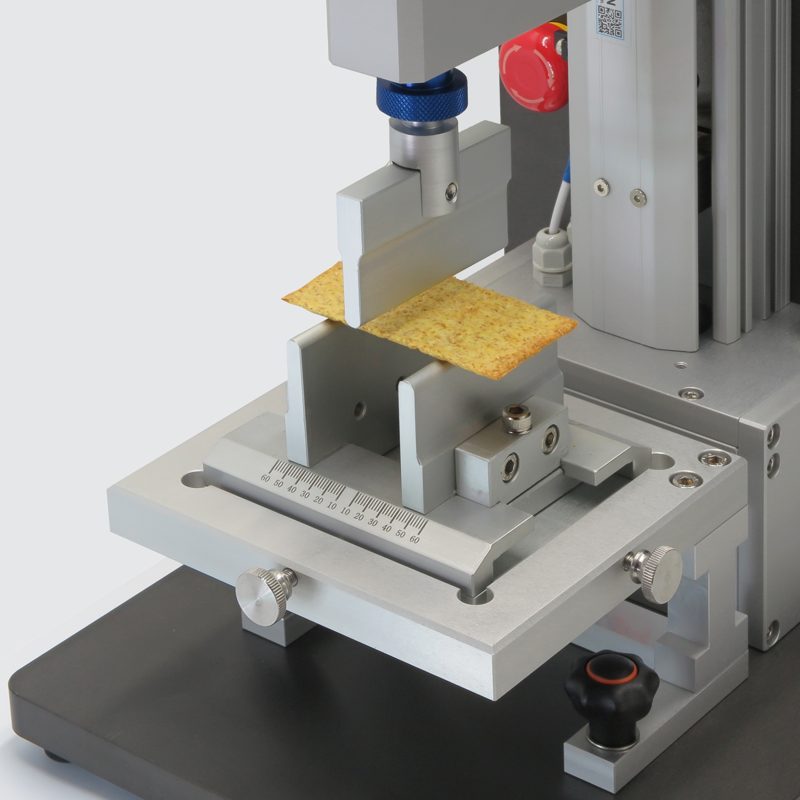
Standard 3-point bending rig
Span 10–100 mm, probe Ø 3–10 mm
Biscuits, crisps, chocolate bars
The most common setup
View probe & test kit →
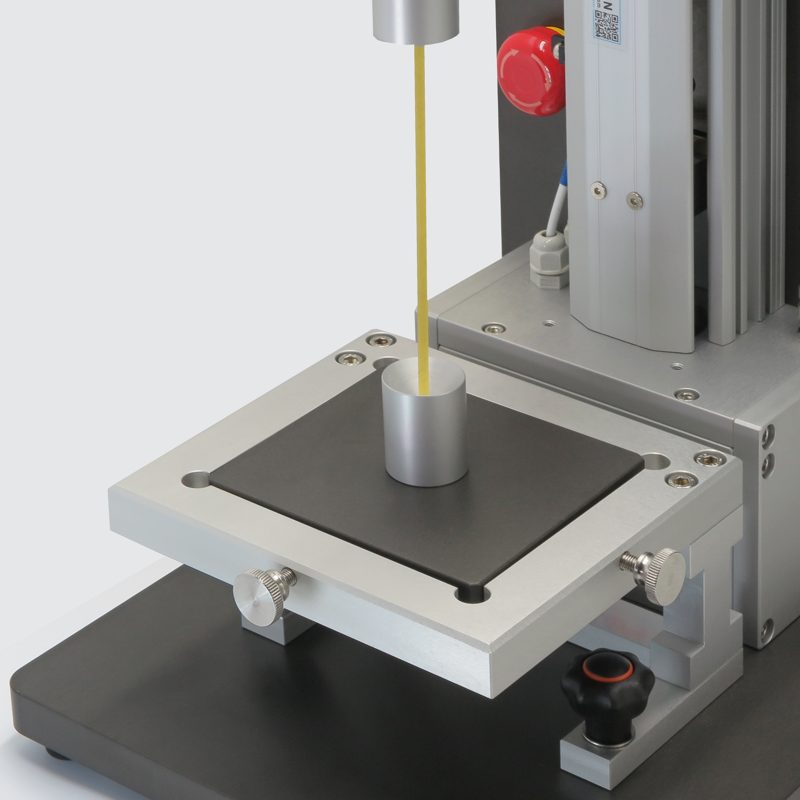
Noodle toughness rig
Span 50–200 mm, roller supports
Pasta, ramen, rice noodles
Large deformation for toughness and extensibility
View probe & test kit →
Thin sheet rig
Span 20–150 mm, adjustable
Films, packaging, plastic sheets
Meets ASTM D790
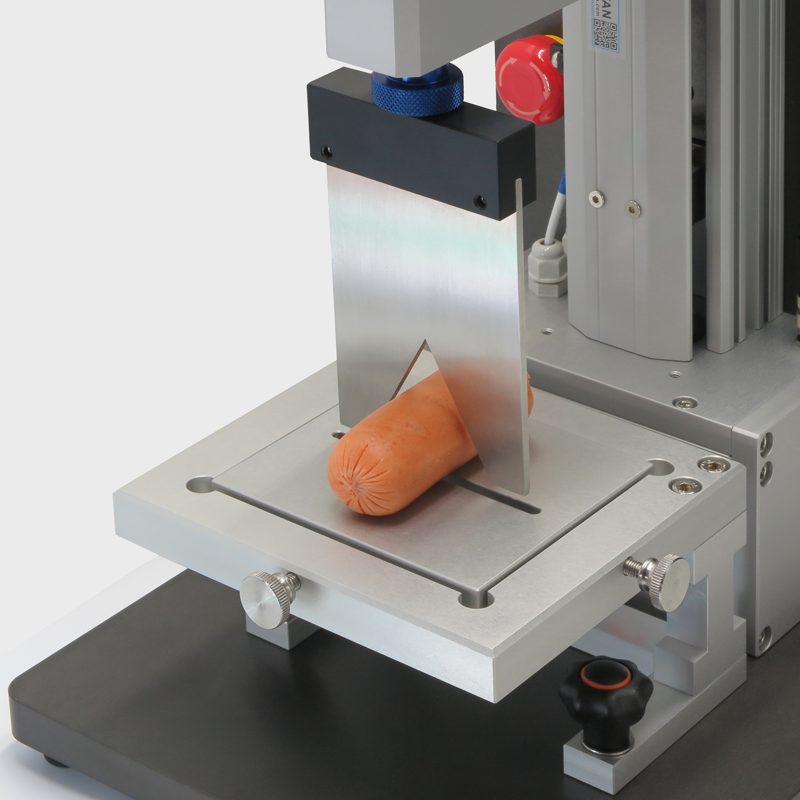
Blade of warner bratzler
BWB
View probe & test kit →
Part 4
Data Interpretation & Analysis
From peak force, span and dimensions, the three-point bending curve gives flexural strength; the slope gives flexural modulus (stiffness); the area under the curve is fracture energy. Brittle samples rise steeply and snap with small deflection; tough samples curve gently, deform plastically and show larger deflection and energy.
Test Curves & Diagrams
Parameters & Calculations
After a test, the software calculates these parameters from the curve
Deflection
Displacement at the sample midpoint.
Flexural strength
Peak bending stress before break, from peak force, span and dimensions.
Distance at failure
Deflection at break — brittleness or toughness.
Formulas
Flexural strength
σ = (3 × F × L) / (2 × b × h²)
F peak force, L span, b width, h thickness. Resistance to bending failure.
Flexural modulus
E = (L³ × m) / (4 × b × h³)
m is the curve slope (force per deflection). Stiffness of the material.
Fracture energy
W = ∫ F × dδ
Total energy to break the sample — the area under the curve.
Part 5
Application Cases
Applicable Test Samples
These samples use this action — select one for the full test information
Application Cases & Data Examples
Fixture choice
Standard 3-point rig (span 10–100 mm): biscuits, crisps, chocolate bars. Noodle toughness rig (span 50–200 mm, roller supports): pasta, ramen, rice noodles. Thin-sheet rig (span 20–150 mm, ASTM D790): films, packaging, plastic sheets.
Part 6
Frequently Asked Questions
How do I choose the support span?
Choose the span from sample thickness and test aim. A common guide is 16–20 times the thickness, so the sample bends rather than shears. For foods, adjust to real sizes; for materials, follow the standard (e.g. ASTM D790). Too short a span causes shear failure; too long needs more force.
How does test speed affect results?
Faster speeds usually read higher force because the material cannot fully relax. Brittle foods (biscuits): 2–5 mm/s to mimic chewing. Tough foods (noodles): 0.5–2 mm/s for more accurate modulus. Keep speed constant across a comparison.
How do I tell brittle from tough from the curve?
The force–deflection curve shows it clearly. Brittle (biscuits): steep straight rise then sudden break, small deflection (usually <5 mm), low fracture energy. Tough (noodles): gentler curve with clear plastic deformation before break, large deflection and high energy. Modulus (slope) also helps: brittle materials are stiffer, tough ones less stiff.
How do temperature and humidity affect results?
Both strongly affect texture: warmer food is usually less brittle and weaker; more humidity softens it and makes it less crisp. Recommendations: (1) equilibrate samples at constant temperature and humidity for at least 24 h; (2) test at 20–25 °C and 40–60% RH; (3) use a temperature chamber for sensitive samples; (4) record all conditions.
How do I improve repeatability?
(1) Standardize sample size; (2) center each sample on the supports; (3) test at least 10 replicates per batch; (4) hold speed and environment constant; (5) calibrate regularly; (6) verify with a reference material. Good practice should keep the coefficient of variation within 10%.
Related Test Actions
Cutting / Shear Test
Mimics teeth cutting through food — measures maximum shear force and fracture behavior.
Learn More →
Puncture Test
Measures puncture resistance — surface hardness, fracturability and gel strength.
Learn More →
Compression Test
Measures mechanical response under compressive load — for hardness and springiness.
Learn More →
Not sure which texture test method fits your product?
Feel free to share your testing needs anytime — we provide free test method recommendations, custom fixture selection, instrument model suggestions, and tailored quotes.